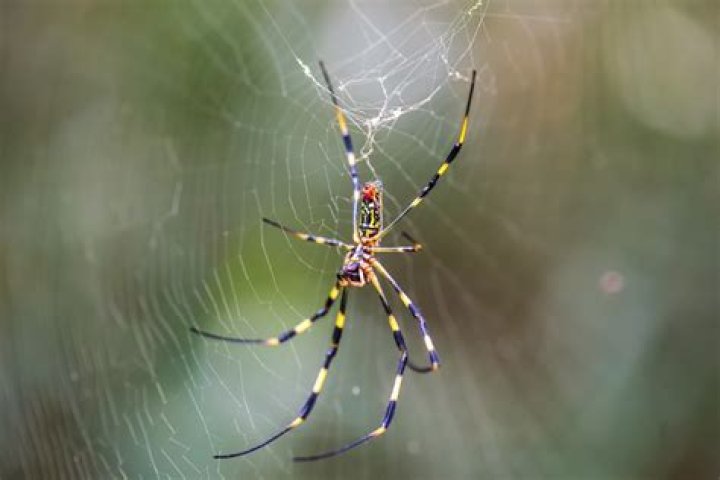
Giant spiders that spin enormous webs are the stuff of horror stories—not the type of thing you expect to encounter on the daily (or, uh, ever). The mere fact that they exist is especially unnerving if you're part of the 3 to 15 percent of the population that has arachnophobia. But even if you're not, many of us prefer spiders we can remove from our homes in a simple Tupperware or piece of tissue paper. So, our ears perked up—and our brains freaked out—when we learned that there is an invasive species of spider that's made its way stateside. It has some pretty scary attributes, and experts say it'll probably multiply faster than expected. Read on to learn what scientists think about the arachnids' arrival.
RELATED: "Very Large" New Spider Species Discovered—Here's Where There May Be Hiding.
Jorō spiders don't belong in the U.S.
The frightening new spider that's appearing across the country is called the jorō—and it doesn't belong here. According to a 2015 study published in the journal PeerJ, the jorō spider likely arrived in the U.S. via a container ship from an East Asian country like Japan, China, Taiwan, or Korea.
They were first spotted in Atlanta, GA, in the fall of 2014; now, the spider is "fully established" in the state, per the study, so the prospect of eliminating it is nothing more than a pipe dream.
Jorōs aren't the first arachnids to hitch a ride to the States and probably won't be the last. "Spiders, largely due to their secretive habits and ability to hitchhike on various commodities, linked with the speed with which these items are transported to North American ports, can easily be introduced inadvertently into novel habitats," wrote the study authors.
Jorōs are famous for their three-inch bodies and six-foot webs.
Allow us to explain the jorō spider: This arachnid is part of a group of spiders called orb weavers since they created "highly organized," yellow-tinted, wheel-shaped webs, according to the pest-control experts at Orkin. The webs can span more than six feet.
The spiders themselves are pretty freaky, too. The females can grow up to three inches, which is twice the size of the males. They have yellow and blue-black abdomens and legs, while the males have a brownish color. The females can lay up to 400 to 1,500 eggs a year. Sometimes, the creatures catch air currents to travel as far as 100 miles, which led some news outlets to call them "palm-sized, flying spiders."
RELATED: Doctors Keep Finding Spiders in People's Ears—These Are the Tell-Tale Symptoms.
They're better suited for city living than experts previously thought.
While jorōs have been on scientists' radar for a while, a new study published Feb. 13 in the journal Arthropoda found they may be more "urban tolerant" than expected. That means they could appear in more states along the East Coast in addition to Georgia, where they're established, as well as South Carolina, North Carolina, Tennessee, Alabama, Maryland, Oklahoma, and West Virginia, where there have been sightings.
One thing that has surprised scientists about jorō spiders in the past is that they often live near major highways. Usually, the vibrations caused by vehicles interfere with spiders' ability to hunt. The recent study found that these vibrations impact jorōs less than they impact other spiders.
"I don't know how happy people are going to be about it, but I think the spiders are here to stay," said Alexa Schultz, a study co-author and third-year ecology student at the University of Georgia, in a statement.
The researchers expect to see the spiders in the Northeast soon, they're just not sure when.
They're ultimately fairly harmless.
Before you get too nervous, know that jorō spiders are not harmful to humans. "We have no evidence that they've done any damage to a person or a pet," said Dave Coyle, an assistant professor at Clemson who has a doctorate in entomology and studies the spiders, to CBS News.
Unfortunately, the jury is still out on their impact on the environment. Coyle noted that areas with jorōs tend to have lower populations of native spiders, which could have ramifications.
As of now, the threat is minimal. If you spot a jorō, experts suggest simply killing it or moving it elsewhere.
You may also need to learn to live with them. "If they're literally in your way, I can see taking a web down and moving them to the side," Andy Davis, a research scientist in the Odum School of Ecology at the University of Georgia and author of a 2022 study on jorōs, said in a press release, "but they're just going to be back next year."
Juliana LaBianca Juliana is an experienced features editor and writer.Read moreFiled UnderNews • Pests • ScienceSources referenced in this article- Source: Nephila clavata L Koch, the Joro Spider of East Asia, newly recorded from North America
- Source: How Urban-Tolerant Are They? Testing Prey–Capture Behavior of Introduced Jorō Spiders (Trichonephila clavata) Next to Busy Roads
Top 10 Things Attracting Spiders to Your House
You can help keep arachnids out by following these simple tips.January 11, 2024Could This Sephora Body Lotion Attract Spiders?
It's a popular product you might have at home.January 10, 2024Doctors Keep Finding Spiders in People's Ears
There have been multiple reports of live spiders removed from people's ears.October 27, 2023Man Nearly Loses Leg to Spider Bite
He was in the hospital for almost a week after noticing a swollen spot on his leg.September 14, 2023Venomous Brown Widow Spiders Are on the Rise
The more aggressive species attacks—and eats—their shy cousins.April 1, 2023The Smart Man's Guide to Spotting Counterfeit Wine
That $2,000 bottle of Bourdeaux might be worth $20. Here’s how to be sure it’s the real thing.April 13, 2017The 5 Best Light-Bodied Red Wines for Extending Your Summer
Don't let September ruin a killer party. August 25, 201717 Insanely Cool New Luxury Bicycles for Spring
Meet the bikes that cost more than a car.March 31, 2017Best Life Essentials
You deserve the best. Live life to the fullest with these ultimate essentials.October 21, 2016This Is the Safest Way to Store Meat
Don't let that filet set you up for food poisoning. February 7, 2018